Showing posts with label GISTEMP. Show all posts

Friday, 2 August 2019

2019 - Temperatures to June

Here is a summary of the first half of 2019 for each of my monitored data sets, and my simple statistical predictions for the year.

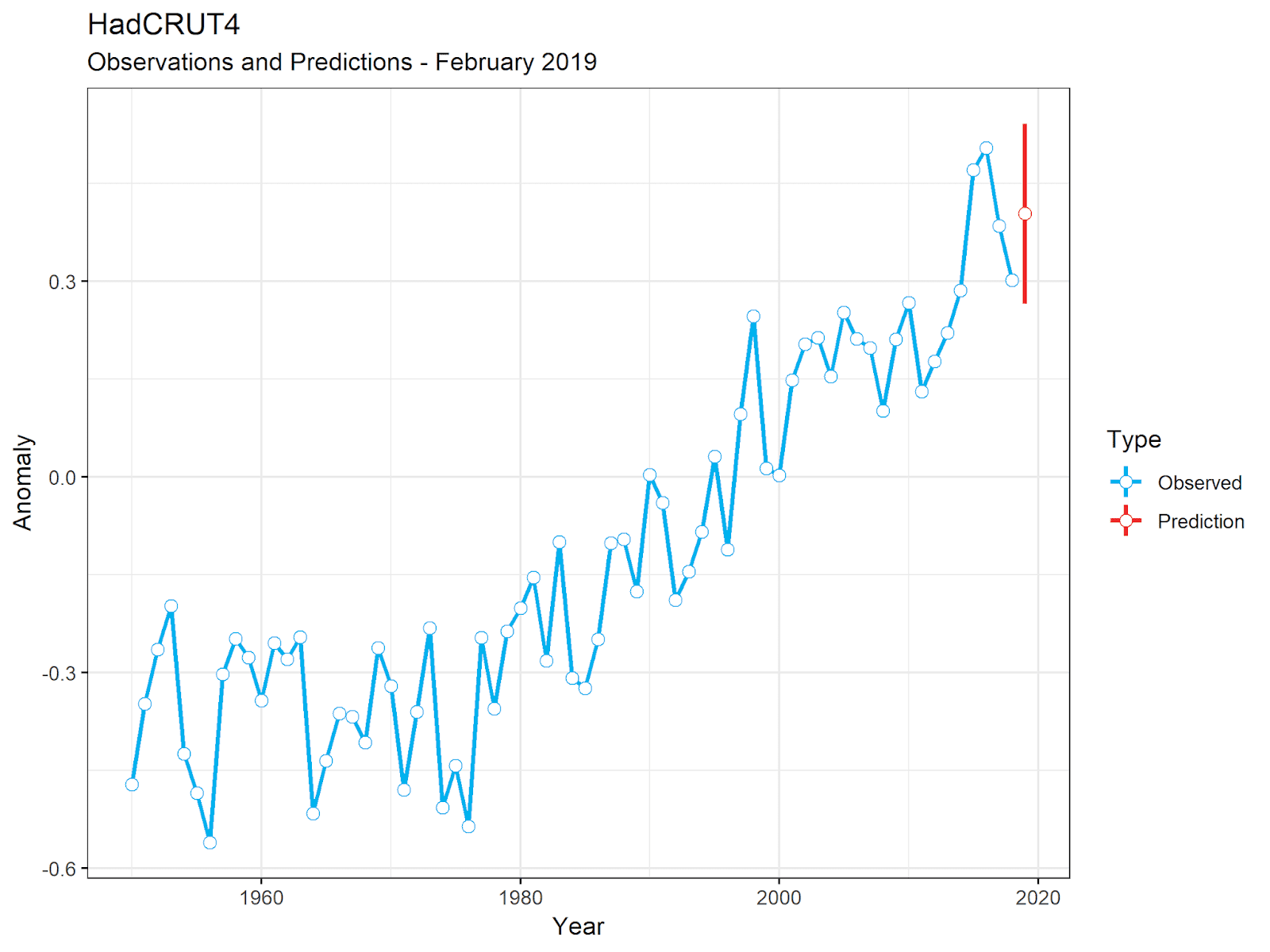
The headline is that so far all data sets are showing 2019 so far to be hot, one of the warmest on records. My prediction is that 2019 is unlikely to be as warm as the record breaking 2016, but is very likely to be warmer than 2018, and is going to at least be in the top 5 warmest years.

This table summarizes each data set, showing the average anomaly (in °C) for the first 6 months of the year, compared to each data sets specified base period. It shows my simple prediction for the final 2019 value, along with the 95% range of predicted values. Finally it shows the expected ranking, that is the position 2019 will be if the final yearly value was as predicted. This doesn't show how close this would be in some cases.

Data Set Average Base Period Prediction Lower Upper Rank
UAH 0.39 1981 - 2010 0.37 0.28 0.46 4th
RSS 0.71 1979 - 1998 0.70 0.61 0.79 2nd
GISTEMP 0.98 1951 - 1980 0.94 0.85 1.03 2nd
NOAA 0.94 1901 - 2000 0.91 0.82 1.00 3rd
BEST 0.93 1951 - 1980 0.89 0.80 0.98 2nd
HadCRUT 0.73 1961 - 1990 0.71 0.62 0.81 3rd

For all data sets except UAH, the range of predicted values suggest 2019 is likely to be between 1st and 4th warmest - though the chances of finishing first is generally pretty low, less than 5%. UAH is likely to be between 3rd and 5th warmest.

The next table shows the probability of each data set beating the various rankings. Note, these are cumulative probabilities, so "3rd" for example is the probability of finishing 3rd or higher. Percentages are given to 1 or 2 decimal places as appropriate. An asterisk indicates the rank of 2018.

Data Set Expected Rank 1st 2nd 3rd 4th 5th
UAH 4th 0.06% 0.76% 24.6% 82.1% 98.4%
RSS 2nd 4.4% 80.5% 96.4% 99.0% 99.3%
GISTEMP 2nd 4.4% 65.1% 82.1% 97.8% * 100%
NOAA 3rd 3.8% 35.4% 55.3% 97.5% * 99.98%
BEST 2nd 2.6% 72.9% 87.2% 98.0% * 99.99%
HadCRUT 3rd 3.5% 13.6% 78.0% 99.3% * 99.8%

Here's the averages and predicted value converted to the same base period (1981 - 2010).

Data Average Prediction
UAH 0.39 0.37
RSS 0.57 0.56
GISTEMP 0.53 0.52
NOAA 0.48 0.47
BEST 0.51 0.50
HadCRUT 0.42 0.42

It's interesting to note that using the later base period has moved the annual predictions closer to the average for the year to date. There's virtually no difference between the prediction and the average, so if true we should expect temperatures for the rest of the year to be only slightly lower than for the first 6 months. I suspect this won't be the case, as ENSO conditions change, and so I wouldn't be surprised if the final temperature is lower than my current predictions.

Some graphs illustrating some of the predictions.

What I find astonishing, and worrying, about all this is not so much the rankings of individual years, but the persistence of the current warm spell. Assuming the predictions for 2019 are not wildly wrong, by the end of the year we will be seeing all surface data sets showing the last 5 years have been the 5 warmest on record, and satellite data showing that the last 5 years have been amongst the 7 warmest on record.

Sources

The above is based on data from the following sources:

UAH
The University of Alabama in Huntsville
RSS
Remote Sensing Systems
GISTEMP
NASA Logo, National Aeronautics and Space Administration National Aeronautics and Space Administration Goddard Institute for Space Studies
NOAA
National Oceanic and Atmospheric Administration
BEST
Berkeley Earth
HadCRUT
Met Office Hadley Centre

Tuesday, 2 April 2019

February 2019 Global Temperature Update

Another brief summary of all the main global temperature data sets for February 2019. As before all anomalies have been recalculated to be relative to the 1981-2010 base period, which may mean that relative changes are different.

February was another month with little change. All data sets show the average temperature as being somewhat warmer than the base period, with anomalies around one third to a half a degree warmer. This is similar to the anomaly for January in most cases, but with HadCRUT and NOAA being around 0.1°C cooler. Compared with last February all data sets show this February being warmer, by around 0.1°C.

February
Dataset Anomaly Change from Last Month Change from Last Year Trend Since 1979 (per Century)
BEST 0.45 0.02 0.06 1.87
GISS 0.45 0.03 0.08 1.73
HADC 0.33 -0.09 0.14 1.7
NOAA 0.32 -0.11 0.09 1.63
RSS4 0.51 -0.01 0.16 1.98
UAH6 0.36 -0.01 0.16 1.28

February 2019 was between the 3rd and 6th warmest February depending on the data set. Here a couple of graphs showing temperatures for the month of February. (Note the scale for GISTEMP is to the 1951-1980 average.)

Predictions

With not much change in the monthly anomalies, and these being close to the warming trend, there hasn't been much change in my predictions. The mid point prediction is virtually unchanged, at most down a few hundredths of a degree. All sets are suggesting there is a good chance of 2019 being warmer than 2018, but with only a small chance of being warmest. The biggest changes from last month is that all sets have reduced the probability of an absolute warmest year, simply because of the slightly narrower prediction intervals.

January - Predictions
Dataset Prediction Interval Top 5 Warmer Than 2018 Record Warmest
BEST 0.44 ±0.13 97.0% 71.0% 2.0%
GISS 0.44 ±0.13 97.5% 71.1% 2.4%
HADC 0.40 ±0.14 95.3% 92.8% 7.5%
NOAA 0.41 ±0.12 94.9% 84.1% 5.3%
RSS4 0.50 ±0.14 80.2% 95.8% 2.5%
UAH6 0.32 ±0.14 76.0% 91.3% 0.4%

A few graphs.

Final Observation

The fact that February was so warm might have came a shock to those who had been a very cold February, especially in the Northern Hemisphere. Here for example is an article on Watts Up With That, Amid the dimmest Sun since 1978 – a month without sunspots, from the 1st March claiming low sunspot numbers were causing severe winters.

It seems the sun has dimmed more than the usual amount at the end of solar cycle 24, and it could be a factor in the severe winter we are experiencing in many parts of the northern hemisphere.

But of course, cold winters in parts of the USA do not mean cold everywhere. Some parts of the Northern Hemisphere, such as the UK, were experiencing extremely warm, even record breaking, temperatures during parts of February, and even some parts of the USA, such as Florida, were very hot.

So strong was the conviction that February was going to be cold that when the UAH data was published in WUWT, here, showing Northern Hemisphere temperatures were 0.46°C above average, the comments erupted in accusations about the unreliability of satellite data, some even suggesting fraud and corruption. For example

Sorry, but this presentation does not pass the BS smell test. The northern hemisphere was featured in story after story about cold records, snow records, lake ice jams, etc, and in the southern hemisphere (where I live) producers are struggling with a decent harvest, which does not suggest a normal summer temperature. This all just does not add up to believable. Can somebody familiar with the data sets figure out what is wrong? Otherwise, I’m going with the obvious: BS!

How is this thing supposed to be measuring temperature? This is for the month of Feb, right?

We have had almost the coldest Feb on record…..we’re 61F right now….when we should be high 70’s to low 80’s

…and it says we’re +2 for the month

Something is definitely wrong…..

Que the usual apologist clergy to lie away the discrepancy.

This is why the contrarians here who constantly defend the constant adjustments and lie about temperature are lying liars who deserve no respect and no polite interaction. Denver Colorado was disastrously cold this year, significantly below average. This is pure Orwellian horse crap

It's all a long time (About 4 years) from the time when anyone who questioned the accuracy of satellite data was branded a satellite-denier.

And next months data from UAH is using an adjusted version showing slightly more warming.

Thursday, 7 March 2019

Temperatures - January Summary

Belatedly here's a brief summary of all the reports of global temperatures for January 2019.

I'm trying a different format this year, and only intend to release single reports for all the main data sets at the end of each month, when all the data is in. One major change is that I want to use a consistent base line, so all anomalies are translated into anomalies relative to the years 1981-2010. I'm not promising I will keep this up all year - it might depend on how much I can automate the work.

Observations

All surface data sets have January at around 0.4 - 0.45°C warmer than the 1981-2010 average, with satellite data not too dissimilar. UAH was a bit below 0.4°C and RSS a bit above 0.5°C. In all cases this is up around 0.1°C compared with last January. UAH have 2019 as the 6th warmest January, all other data sets have it as the 4th warmest.

This table summarizes some of the details

January
Dataset Anomaly Change from Last Month Change from Last Year Trend Since 1979
BEST 0.44 -0.03 0.08 1.88
GISS 0.43 -0.06 0.11 1.71
HADC 0.41 0.08 0.18 1.71
NOAA 0.43 0 0.16 1.64
RSS4 0.52 0.12 0.11 1.98
UAH6 0.37 0.12 0.11 1.28

Hopefully that's not too confusing. It shows each data set, with the anomaly for January in Celsius compared with the 1981 - 2010 base period. It also shows the change of that anomaly compared with the previous month (December 2018) and compared with the same month last year (January 2018). Finally it shows the trend since 1979 in Celsius per century. 1979 is used as a start date for consistency with the satellite data.

Predictions

Too soon to take any predictions seriously, but on the basis of one month the prediction would be for 2019 to essentially the same as January, purely on the basis that January was very close to the long term trend.

This table lists the predicted values in °C compared with the 1981-2010 average, and gives the probability of reaching various milestones. So far on the basis of one months data, it seems probable that 2019 will be warmer than 2018, and for surface data, very likely to be one of the 5 warmest years on record. Satellite data is also likely to be in the top 5, but this is less certain due to the strength of 1998 and 2010 in the satellite data. There is a small chance that 2019 will be the warmest year on record, purely due to the natural uncertainty of the coming months, but realistically this seems unlikely to me unless there is a big El Niño in the coming months.

January - Predictions
Dataset Prediction Interval Top 5 Warmer Than 2018 Record Warmest
BEST 0.45 ±0.14 96.6% 72.0% 3.0%
GISS 0.44 ±0.14 97.4% 71.7% 3.8%
HADC 0.42 ±0.15 95.8% 93.8% 14.5%
NOAA 0.44 ±0.14 96.6% 87.7% 13.2%
RSS4 0.50 ±0.16 76.1% 92.7% 5.0%
UAH6 0.32 ±0.18 70.2% 85.0% 1.7%

Finally here are some of the predictions in graph form.

Monday, 11 February 2019

2018 Temperature Roundup

Somewhat belatedly, due to the weirdness of American government and the fact I've had better things to do, here is the final round up of 2018.

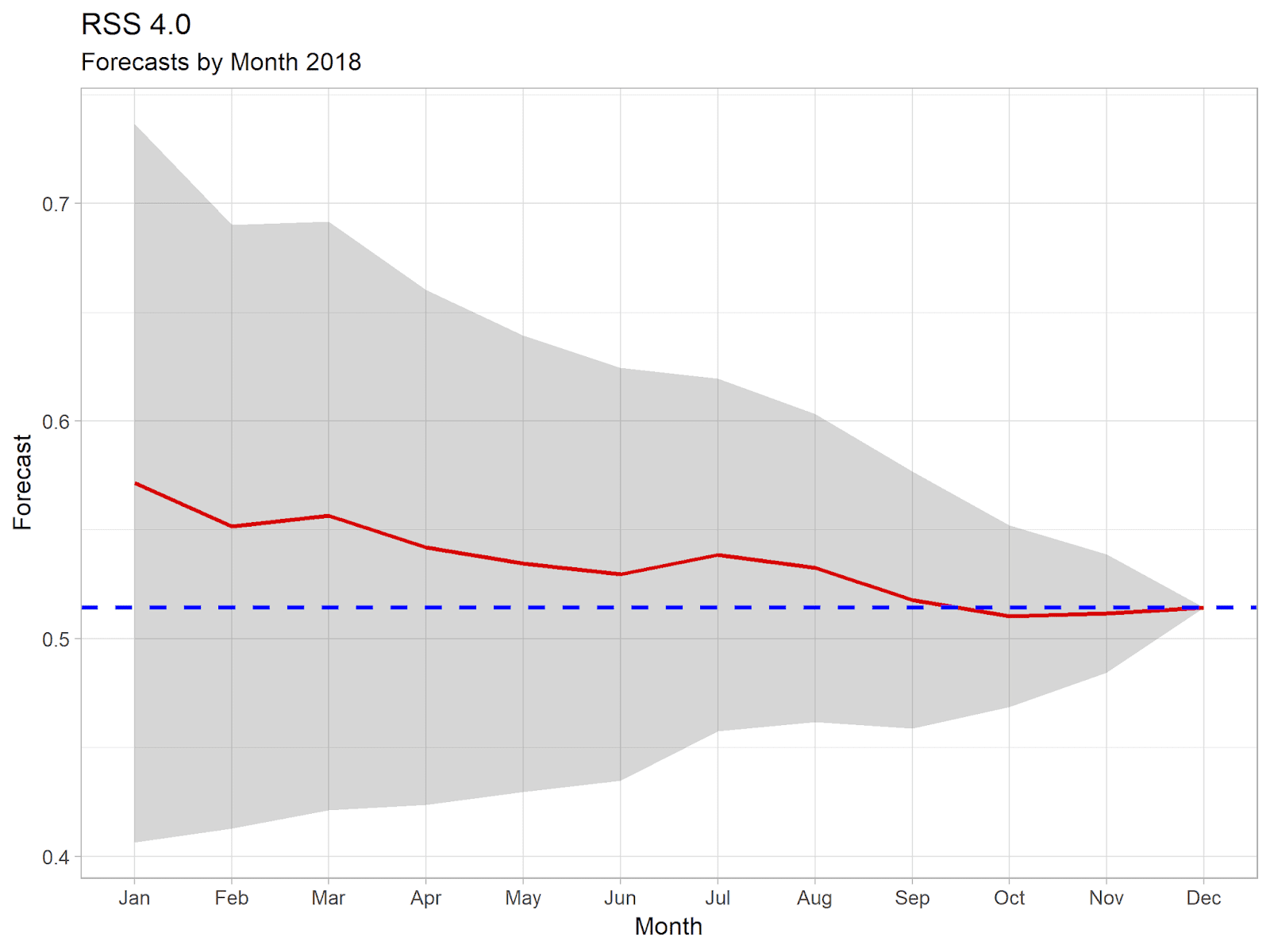
This is going to be very brief, with just the graphs showing annual temperatures for each data set, along with a graph showing how my forecast progressed through the year. The forecast graph shows a red line representing the predicted annual anomaly after each month's data had been released, and a grey area showing the 95% confidence interval in that prediction. The blue dotted line shows the final figure for 2018.

Note, that as always the predictions have been calculated from current data. Actual forecasts made at the time might have been different as the initial release of monthly data is provisional and generally changes as more data is added.

Temperature's in 2018

Both satellite data sets show 2018 as being the 6th warmest. All surface data sets show 2018 as being 4th warmest. The main difference here is that satellite data shows the strong El Niño years of 1998 and 2010 as being much warmer than surface data sets.

UAH and HadCRUT, could be considered to be statistically tied for 6th or 4th place respectivly, in other cases there is little doubt about the rankings. All surface data sets show the last 4 years to have been the 4 warmest on record, and all but BEST show the last 5 years to have been the 5 warmest on record. Satellite data shows the last 4 years to have been 4 of the 6 warmest years on record, with only 1998 and 2010 spoiling the clean run.

More importantly, all data sets continue to show a consistent warming trend since the 70s. For UAH this trend is around 1.3°C / century. For all other sets this is around 1.7 - 1.9°C / century. All data sets show 2018 as being very close, if slightly below, the trend. Of course, none of this will stop the usual claims in some quarters that there has been rapid cooling since 2016.

As for my predictions, I'd have to say that this year they were remarkably accurate even from January, rarely more than a few hundredth of a degree out. I'd like to suggest this shows how amazing my simple prediction algorithm is, but in reality it just reflects the fact that 2018 was a very dull year, with little variation in monthly temperatures and all close to where you'd expect given the trend.

Satellite Data

UAH
RSS

Surface

HadCRUT
GISTEMP
BEST
NOAA

Saturday, 17 November 2018

Temperature Update - October 2018, GISTEMP

According to GISTEMP, global temperatures for October 2018 were 0.99°C above the 1951-1980 average. This is quite some rise, though you shouldn't put too much store in any individual month. It's up by 0.25°C from last months anomaly and is the warmest monthly anomaly of the year. It puts 2018 as the 2nd warmest October in the GISTEMP history, starting in 1880.

Tuesday, 16 October 2018

Temperature Update - September 2018 - GISTEMP

According to NASA's GISTEMP the global surface temperature for September was 0.75°C above the 1951-1980 average. In contrast to the satellite data this is only slightly down on the anomaly in August of 0.77°C, and is the equal 6th warmest September on record. It ties with September 2005, and apart from this the last 6 Septembers have been the warmest 6 on record.