The NASA and Goddard Institute for Space Studies GISTEMP anomaly for June 2018 is 0.77°C above the 1951 - 1980 average.
This is the coolest monthly anomaly of the year, slightly cooler than January's 0.78°C.
This is more an indication of how warm the year has been so far.
June is the equal third warmest June on record, equal with June 1998 and 0.03 cooler than the record June of 2015.
Temperatures remain very close to the trend since 1970, of 1.81°C / century.
Prediction
My prediction for 2018 is 0.825±0.088°C, virtually unchanged from last month's prediction of 0.826±0.101°C.
This is also very close to the current average for the first 6 months of 0.828°C.
The probability of 2018 being the 4th warmest, between 2014 and 2015, is now more than 80%.
There is only a small chance (~2.5%) of finishing below 2014.
It is still plausible (~15%) that it will finish 3rd or 2nd.
GISTEMP
Rank
Year
Anomaly
Probability
Cumulative
1
2016
1
0.02%
0.02%
2
2017
0.9
4.46%
4.48%
3
2015
0.87
10.61%
15.09%
4
2014
0.74
82.25%
97.34%
5
2010
0.7
2.27%
99.62%
6
2005
0.68
0.31%
99.92%
7
2013
0.65
0.07%
99.99%
8
2007
0.64
0.01%
100.00%
Finally, this graph shows how the prediction has changed during the first half of the year,
with the red line showing the average predicted value based on each months data, and the grey area showing the 95% interval.
As with other data sets the fact that there has been very little change in the forecast reflects monthly temperatures being very close to those expected by the long term trend (since 1970).
A brief update on the Remote Sensing System (RSS) satellite global temperature, for June 2018.
This has the anomaly for June as 0.465°C above the 1979 - 1998 base period.
As with UAH this is similar to April's anomaly and slightly up on May's.
June 2018 was the 7th warmest July in the 40 year RSS data set.
The last 6 Junes have been 6 of 8 warmest on record.
The trend for all months over the RSS data set, starting in 1979, is 1.95°C / century,
with June continuing the pattern of being slightly below the trend.
The average of the last 12 months remains just above the trend line.
Prediction
My prediction for 2018 continues to drop slightly, at 0.526 ± 0.095°C, compared with last months prediction of 0.530 ± 0.105°C.
It is most likely that 2018 will finish 6th warmest, between 2014 and 2015.
The estimated likelihood of this is around 75%, compared with 68% last month.
There is only a small chance of it finishing below 6th warmest (around 3.5%), in which case it would most likely finish in 8th place.
On the other hand there is a better than 20% chance of finishing above 2015 for 5th or better, with 3rd place still being possible.
Full details of probabilities listed below.
RSS 4.0
Rank
Year
Anomaly
Probability
Cumulative
1
2016
0.76
0.00%
0.00%
2
2017
0.65
0.70%
0.70%
3
2010
0.59
7.47%
8.16%
4
1998
0.58
4.36%
12.53%
5
2015
0.56
9.02%
21.55%
6
2014
0.44
75.01%
96.55%
7
2005
0.44
0.30%
96.85%
8
2003
0.39
2.74%
99.59%
9
2013
0.39
0.15%
99.74%
10
2007
0.39
0.02%
99.76%
12
2006
0.35
0.20%
99.96%
13
2009
0.35
0.01%
99.98%
14
2012
0.32
0.02%
100.00%
The average predicted annual value has been mainly dropping throughout the first 6 months of the year,
but only slightly, sown about 0.05°C since the prediction in January.
The changes so far are well within the 95% confidence interval.
Halfway through the year and global temperatures continue to be dull, at least according to The University Of Alabama in Huntsville (UAH) satellite data.
Dr Roy Spencer announces that the anomaly for June was 0.21°C above the 1981 - 2010 average.
This is the same anomaly as for April and 0.03°C above May, and 0.05°C below January, the month with the highest anomaly.
So far has only been 0.08°C difference across the range of all months of 2018.
This isn't quite the flattest start to a year in UAH history, 1979 and 2002 both had ranges of 0.07°C over the first 6 months, but it is unusual -
the average January to June range is 0.25°C.
June 2018 was the 9th warmest June in the UAH data set.
Anomalies for the month of June - UAH6
This graph also gives the impression that Junes as a whole have become more static.
Since 2010 there has been relatively little variation in June temperatures compared with the big year to year swings seen previously.
I doubt if much can be read into that, it's just a curious observation.
The monthly anomalies continue to be just below the overall trend line.
Monthly UAH6 Anomalies with 12 Month Moving Average and Trend
My prediction for 2018 remains almost unchanged at 0.244 ± 0.091°C, compared with last month's 0.242 ± 0.103°C.
The actual average for the first 6 months of the year is 0.218°C, so this prediction does assume a slight rise in the second half of the year.
This in turn is because temperatures are currently just below the trend and the assumption is that it's more likely that temperatures will return to the trend than away from it.
It does not take into account any forecasts such as the expected ENSO value.
There has been very little change in the predicted value so far this year, which shouldn't be surprising given the lake of variation in the reported anomalies.
In terms of ranking, UAH continues to show the least certainty, mainly because there is less of a trend in their data.
6th place has the highest probability, but that is still less than 50%.
There is around an 80% chance that 2018 will be between 5th and 7th warmest, but with a reasonable possibility it will finish below 7th, possibly as low as 11th.
It is unlikely to finish above 5th place.
The Met Office Hadley Centre, HadCRUT, data set has the anomaly for May 2018 at 0.596°C above the 1961-1990 base period.
This makes 2018 the 5th warmest May in the data set, with the last 5 Mays being the 5 warmest, (although there's very little difference between 2018 and the 6th warmest in 2010).
Anomalies for months of May (relative to 1961 - 1990 average) - HadCRUT 4
May continues the story of 2018 being slightly below the trend from 1970.
Monthly Anomalies for HadCRUT4, with 12 Month Moving Average and Trend since 1970
The average for the first 5 months of 2018 is 0.585°C, up slightly from the first 4 months of 0.582°C.
My prediction based on a simple statistical analysis is that 2018 will have an average anomaly of 0.612 ± 0.106°C.
This is almost unchanged from the previous prediction from data up to April of 0.613 ± 0.115°C.
It is most likely (~60%) that HadCRUT will finishing as the 4th warmest year on record, with a greater than 80% chance of finishing between 3rd and 5th.
However, it is unlikely to be above 3rd place, ans there is a reasonable chance of finishing below 5th, in which case it could be much lower, with a small chance of being below 13th.
I should have mentioned this earlier, but people of New Orleans are in grave danger.
Piers Corbyn the alternative weather forcaster who claims to be able to predict the weather months in advance with proven skill verified by independent academic statisticians and published in scientific literature,
has a message on his website,
archived here warning of a hurricane that will hit near New Orleans.
WeatherAction* Public Hurricane Warning for likely Cat2 hit on Usa Gulf coast likely near NewOrleans about Jun29 +-1 day or so.
Pass it on - WARN any contacts you know in Usa
*This warning is in line with WeatherAction policy to make LongRange Forecasts public when dangerous weather is likely.
I realize I might have left this a little late to pass on the warning, it already being the 29th, and with no forecast of any event from the official sources (or charlatans as Piers would have it).
The Goddard Institute for Space Studies have released the update for their GISTEMP data set.
May 2018 was 0.82°C above the 1951-1980 base period.
This makes 2018 the 4th warmest May in the data set, with the last 5 Mays being the warmest on record.
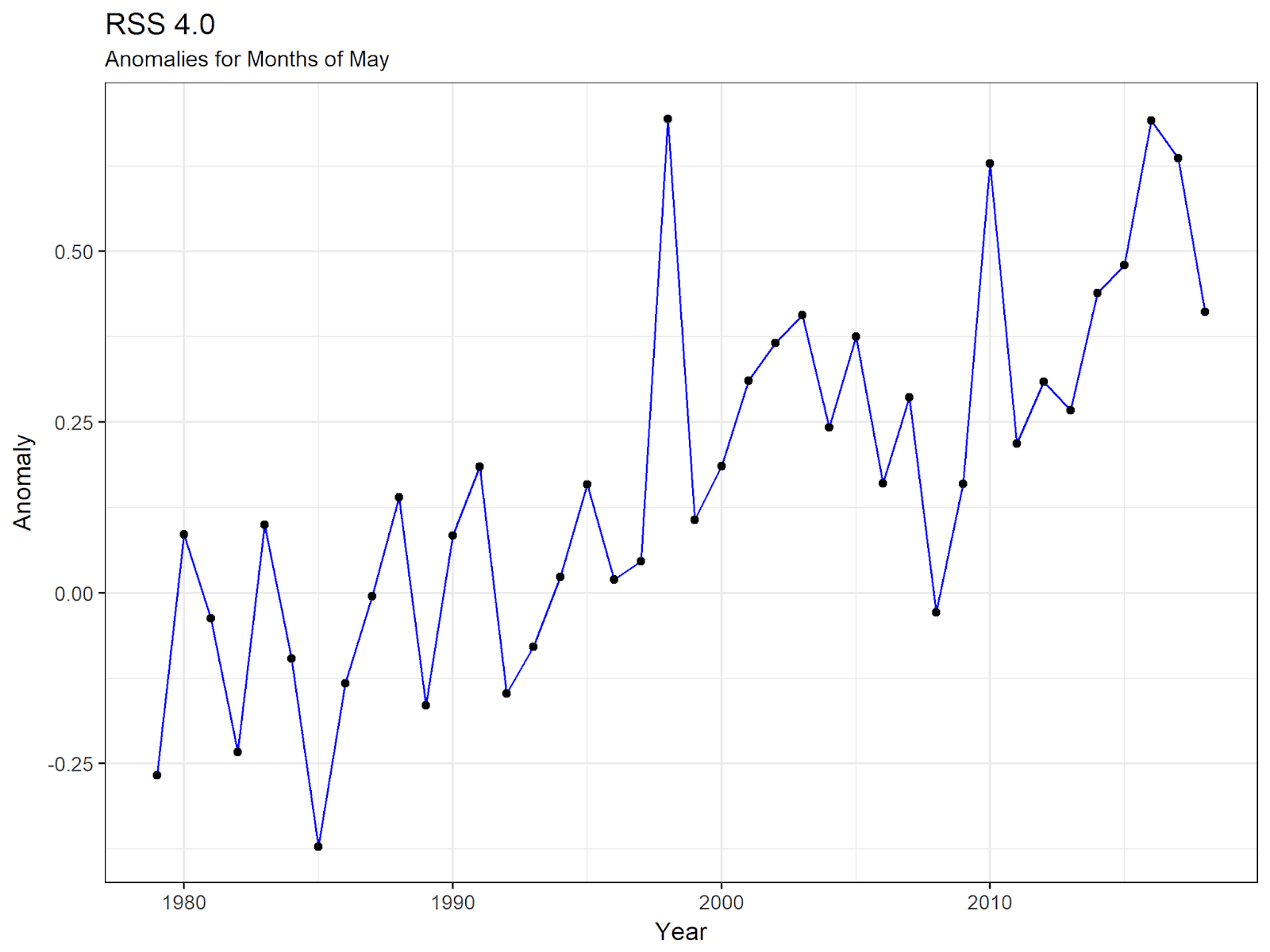
Remote Sensing Systems (RSS) has the lower troposphere at 0.41°C warmer than their 1979 - 1998 base period.
If RSS used the same base period as UAH, this would mean RSS would have an anomaly of 0.30°C.
Both data sets show a continuing fall in anomalies, with May being the coolest seasonally adjusted month of the year.
UAH has 2018 as the 10th warmest May in its 40 year history.
RSS had the 7th warmest May.
Both data sets show May as being more noticeably below the trend line, but not in any way unusually so.
The trend for both data sets is somewhat different, with UAH warming at the rate of 1.28°C / century, and RSS at the rate of 1.92°C / century.
All surface data sets fall between these two extremes over the same period, though generally a lot closer to RSS than UAH.
Predictions
The statistical prediction for each data set takes into account both the average anomaly for the year so far and the underlying trend.
For UAH the prediction based on data up to May is for 2018 to have an average anomaly of 0.242 ± 0.103°C, compared to the prediction based on data up to April of 0.246 ± 0.117°C.
This compares with the current average for the year of 0.22°C.
For RSS the current prediction is 0.520 ± 1.05°C, compared with last month's prediction of 0.527 ± 0.118°C.
This compares with a current average of 0.487°C.
Predictions for Rankings
UAH has the most uncertainty of all the data sets, mostly because of it's slower rate of warming.
5th or 6th (~66%), with little chance of finishing above 5th, but with a reasonable chance (~30%) of finishing below 6th, possibly as low as 12th.
For RSS there is now almost a 70% likelihood of finishing 6th, with only a small chance (~5%) of finishing below 6th, but with a reasonable (~25%) of being higher than 6th, possibly as high as 3rd.
Comparing these probabilities with those for surface data it's worth noting the role that the two strong El Niño years play in the satellite data.
1998 and 2010 are still among the warmest years in satellite history, but in surface data are relatively cooler.
Satellite data is tending towards 2018 being 6th or so warmest, whilst surface data is likely to be around 4th warmest, but in terms of recent years both are looking very similar.